How Refinishing Your Floors Can Transform a Maryland Home
From humid summers to salt-tracked winters, Maryland is hard on hardwood. Here is how refinishing (or a smart luxury vinyl swap) can transform your home, room by room.
There is a moment, usually in late spring, when the low morning light comes across the floor at just the right angle and shows you every scuff, every gray traffic path, every water ring by the back door. If you own an older Maryland home, you know the one. Our floors work hard here, and after a few years they start to look tired long before they actually are.
The good news is that tired is not the same as done. Refinishing existing hardwood is one of the few home projects that delivers a dramatic, whole-room transformation without knocking down a single wall. If you are considering it, it is worth starting with a trusted crew for hardwood refinishing in Maryland, and for older boards that need real repair before they can be saved, experienced hardwood restoration contractors in Maryland can bring century-old floors back from the edge.
Why Maryland floors age the way they do
Our climate is genuinely tough on wood. Summers along the Bay run hot and humid, and hardwood expands with all that moisture in the air. Winters are dry, and the boards shrink back. That seasonal push and pull, year after year, opens up little gaps, loosens finish, and works dirt down into the grain.
Then there is the grit. Sand tracked in from Ocean City and the Eastern Shore, road salt and brine dragged in on boots from December through March, and the fine dust that comes with living near so many tree-lined streets in places like Bethesda, Towson, and Ellicott City. Salt in particular is brutal — it is abrasive and it draws moisture, so a winter’s worth of it grinding underfoot dulls a finish fast.
The result is that a lot of Maryland floors look far worse than they are. The wood underneath is often solid oak or pine with decades of life left. What is failing is the finish on top, and that is exactly what refinishing renews.
What refinishing actually changes
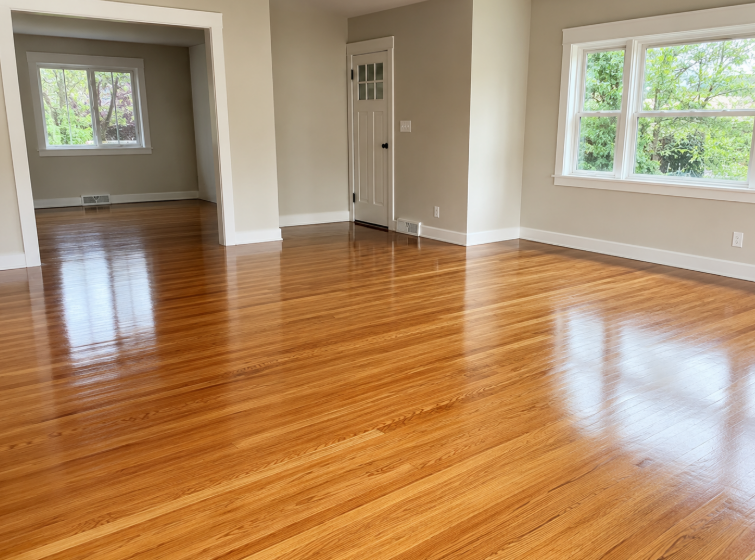
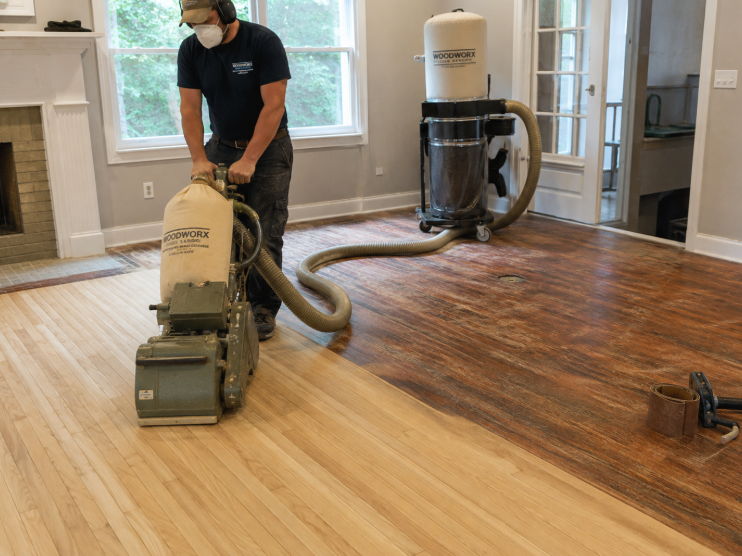
A proper refinish sands away the old, worn topcoat and a whisker of wood with it, erasing surface scratches, gray oxidation, and old stains. Then fresh stain and a new protective finish go down. The effect is not subtle. Rooms get noticeably brighter because a clean finish reflects light instead of absorbing it through a hazy, scuffed surface. Colors deepen. The grain comes back to life.
It is also a chance to change the whole mood of a room. A lot of Maryland homes from the 1980s and 90s have that orange-toned honey oak. Shifting to a warmer natural matte, a rich walnut, or one of the popular white-oak looks can make a dated space feel current without any other renovation. Same floor, completely different house.
Older homes in Baltimore, Annapolis, and Frederick often have narrow-plank or heart-pine floors that are worth preserving for their character alone. When boards are cupped, cracked, or missing near old radiators and thresholds, that is where restoration comes in — board replacement, filling, and re-leveling before the refinish, so the final result looks original rather than patched.
The value case, locally
Beyond looks, floors move the needle on resale, and that matters in a competitive market like ours. Buyers touring homes around the DC and Baltimore metros consistently react to floors first — it is the largest continuous surface they see, and refinished hardwood reads as “well maintained” in a way few other updates can. Compared to the cost of new flooring, refinishing what you already have is a fraction of the price for a comparable visual payoff.
It is also faster and less disruptive than most people expect. A typical few rooms can be sanded, stained, and coated in a matter of days rather than weeks, and you keep the original wood that gives an older Maryland home its soul.
When vinyl is the smarter call
Refinishing is the right answer when you have real hardwood worth saving. But plenty of Maryland homes have spaces where wood was never the practical choice — finished basements below grade, sunrooms and additions on concrete slabs, mudrooms that catch every bit of Bay sand and winter salt. In those rooms, humidity and moisture make solid hardwood a losing battle.
That is where luxury vinyl plank installation earns its keep. If you are choosing between tearing out old carpet, fighting a damp basement slab, or covering concrete in an addition, LVP is waterproof, dimensionally stable through our humidity swings, and convincingly wood-like underfoot. It handles the mudroom-and-basement realities of Maryland living far better than carpet, which traps that tracked-in moisture and never fully dries out down there.
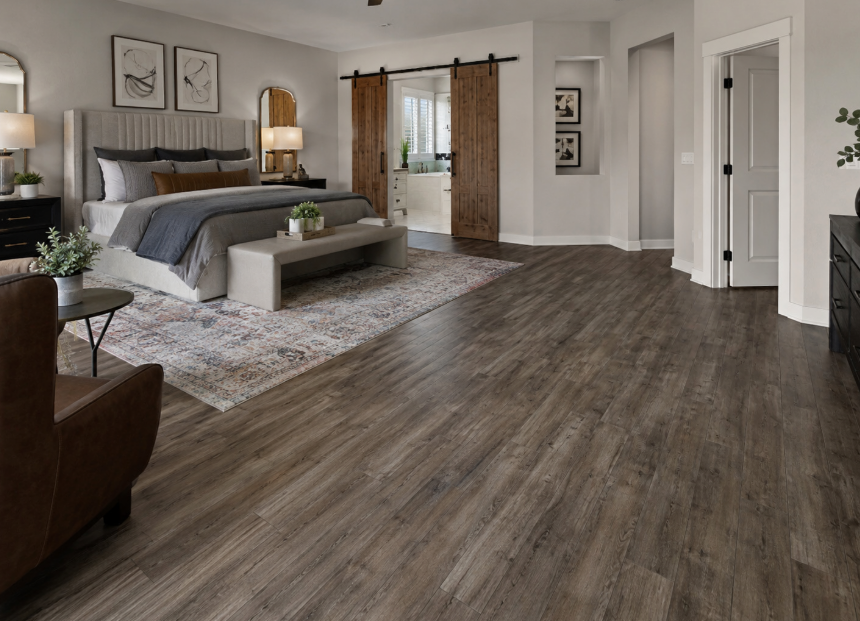
Many homeowners here end up doing both: refinishing the original hardwood in the main living areas where it belongs, and running LVP through the basement, sunroom, and mudroom where wood would only struggle. The two finishes can be color-matched closely enough that the house reads as one cohesive whole.
A few local timing tips
- Aim for the shoulder seasons. Late spring and early fall give you moderate humidity, which helps finishes cure evenly and lets you open windows for ventilation. Deep summer humidity can slow drying.
- Do it before you re-carpet or move furniture in. If you are already emptying rooms, that is the cheapest time to refinish.
- Handle the salt problem at the door. Once your floors are done, a good entry mat and a no-shoes habit through the winter will protect that new finish from the brine and grit that dulled the old one.
Refinishing is one of those rare projects where the reward is out of all proportion to the effort. You spend a few days, keep the floor you already own, and walk into a home that feels brighter, cleaner, and years younger — which, for a house that has weathered its share of Maryland summers and winters, is exactly the transformation most of us are after.